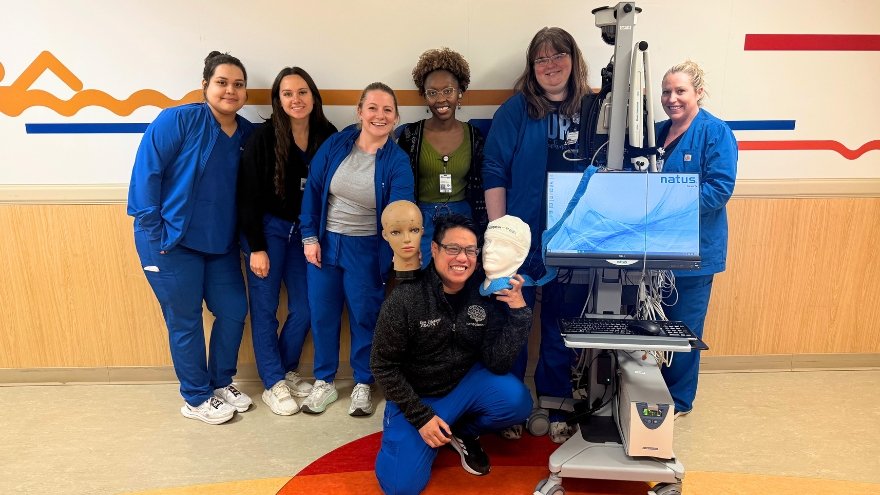
When a patient is experiencing unexplained seizures, nerve pain or neurological symptoms that don't have a clear cause, finding answers often begins with one critical step: a diagnostic study performed by a skilled neurodiagnostic technician. At Renown Health, the Electrodiagnosis (or Neurodiagnostics) department provides these essential services every day.
Think of our Electrodiagnosis team as your brain puzzle masters. Their impact spans both inpatient and outpatient settings, serving patients of all ages who are living with epilepsy, a traumatic brain injury, neuropathy, ALS (Lou Gehrig’s disease) and more. While their work may look like "squiggly lines" on a screen, the insights they capture are anything but simple.
Reading Between the Lines
The Electrodiagnosis team is home to all of Renown’s neurodiagnostic technicians (also known as EEG technicians) and specialists. These talented techs perform tests with advanced technology to help doctors diagnose brain and nervous system conditions, including electroencephalograms (EEGs) to monitor brain activity and nerve conduction studies (NCS) and electromyography (EMG) to assess nerve and muscle function.
No two days look the same in the Electrodiagnosis department. Technicians may start their morning setting up long-term EEG monitoring for a hospitalized patient and end the day performing outpatient nerve conduction studies in the clinic. Throughout it all, precision, adaptability and patient care remain at the center of everything they do.
"A typical day starts early for me. I begin at 5 a.m. by taking a report from the night team," said Marcel B., Neurodiagnostic Specialist. "I check on all patients connected to 24-hour EEG studies to make sure their equipment is functioning properly, then review the list of studies ordered for the day, especially any STAT EEGs that need immediate attention."
In a typical shift, neurodiagnostic technicians may complete around three long-term monitoring setups, two routine EEGs and several rounds of troubleshooting, fixing and discharging. All of this ensures accurate data collection and supports neurologists in making informed decisions about patient care.
On the outpatient side, the team sees patients for routine EEGs and NCS/EMG appointments that help diagnose conditions affecting the nerves and muscles throughout the body.
"For outpatient EEGs, I see patients that come in sleep deprived, and I apply electrodes on their head and let them attempt a nap for 30 minutes," said Ashley D., Nerve Conduction Study Technologist and EEG Technician. "I perform seizure protocols like hyperventilation and photic stimulation to see if any abnormalities are produced. For NCS/EMGs, I do the nerve conduction study first, and the provider does the EMG after. This study is looking for neuropathy, myopathy, motor neuron disease or radiculopathies."
"When performing nerve conduction studies, we see how fast the stimulation travels through the nerve and if there is any slowing," added Emma-Leigh V., EEG Technician. "There are so many nerves in the body, and it can be a puzzle to determine what is going on for the patient."
Whether working bedside in the intensive care unit (ICU) or in the outpatient setting, the team provides a service that gives the medical team insight into things that no other test could.
"We go to almost every floor and play a key role in neuromonitoring patients," said Bethany B., Travel Neurodiagnostic Technologist. "We provide a service that can make a real difference in a patient's life, especially in instances where they have medical problems that are not visible to the naked eye. It can also be vital in obtaining a diagnosis for someone who has been advocating for a long time about their condition.”
Many Paths, One Passion
One of the most remarkable things about the Electrodiagnosis team is how each member found their way into this specialized field. From medical assistants (MA) to rehab technicians to certified nursing assistants (CNA), their diverse backgrounds and educational achievements have enriched the team and brought unique perspectives to patient care.
"I started at Renown as a CNA on the Neuroscience Unit, where I gained foundational experience working with neurological patients," said Marcel. "I later advanced into a Critical Care Technician role, which allowed me to work even more closely with the Electrodiagnosis team. That exposure sparked my interest in EEG and the diagnostic side of neurology. I recently completed my formal training through Trusted Neurodiagnostic Academy and am currently preparing to take my board exam. I also earned my certification as a Spanish-to-English medical translator, which allows me to support Spanish-speaking patients and families more effectively.”
Emma-Leigh’s path was equally unique: "I have a Bachelor of Arts in Health and Human Performance, Business Administration and Psychology. I started at Renown Rehabilitation Hospital as a Therapy Technician, then moved into a discharge planning assistant role there. I became interested in apprenticeship programs at Renown, and that’s when I found the world of neurodiagnostics.”
Like Emma-Leigh, Beau V., EEG Technician, also entered the neurodiagnostic field through one of Renown's apprenticeships, which offers multiple pathways for candidates with various educational backgrounds to enter this rewarding career.
“Renown has a very good reputation and allows for career growth, plus I have amazing co-workers, and I enjoy helping people,” said Emma-Leigh.
For Ashley, it was all about the Reno-Tahoe area and working for a top healthcare network: “I moved to Reno seven years ago and love the area; I wanted to work somewhere that serves the highest, best care in the area.”
Bethany, on the other hand, got her degree in neurodiagnostics after a lifetime of being fascinated by the brain and worked at teaching hospitals throughout her training.
"I chose this field because to me, the brain is the most interesting part of a person,” said Bethany. “Who they are, what they feel and why: it all comes down to neuroscience. EEG is a modality that allows me to spend time with patients one-on-one and go a step further in terms of patient care."
Compassion at the Core
Neurodiagnostic studies can feel unfamiliar or even intimidating for patients. Imagine having electrodes on your scalp, experiencing electrical stimulation along the nerves and being sleep deprived all at once — it’s natural for anyone to feel uneasy in that environment. Luckily for patients of Renown’s Electrodiagnosis department, they lead with care and empathy every step of the way. This team understands that behind every study is a person looking for answers.
"Renown’s values that resonate most with me are Compassion and Integrity," said Marcel. "We have the opportunity to work with many different patients every day, often during moments when they feel vulnerable or unsure. Showing compassion helps me support them with patience, understanding and kindness."
"To me, Compassion resonates the most," added Bethany. "Compassion in healthcare translates to the recognition of a patient's suffering combined with an active desire and action to alleviate it, moving beyond mere empathy to practical, caring support. We advocate for our patients and want them to succeed."
In the outpatient setting, the team creates a welcoming environment from the moment a patient walks through the door. Whether it is a child experiencing seizures for the first time or an adult undergoing nerve testing, comfort and trust are always the priority.
"I usually start by getting the rooms ready for my patients, getting toys ready for the kids that we see who are having seizures, so the parents can be at ease with their child and the help that they are getting," said Beau. "In our outpatient team, we value all of Renown's values by having compassion for our patients, integrity by checking in on how they are doing, and collaboration with our team to pick up where one tech left off."
"We especially value People First, Compassion and Collaboration in outpatient EEG," said Emma-Leigh. "Putting the patient first is very important: ensuring their safety and making sure they feel comfortable, listening to the patient as they tell you their concerns, and collaborating with my colleagues on reading studies so I can have the ability to ask questions and get tips and tricks."
Growing Together
Despite being a small department, the Electrodiagnosis team has seen meaningful growth over the past year, both as a unit and as individual professionals.
"One accomplishment I'm especially proud of this past year is how much I've grown in my role," said Marcel. "When I first started, completing even just one study required supervision. Over time, with practice, support and dedication, I've become confident and independent in performing EEG studies on my own. Now I'm able to complete multiple long-term monitoring setups, routines, troubleshooting and discharges in a single shift."
"I am most proud of the technicians that I train who succeed," added Ashley, sharing a sentiment that speaks to the team's investment in growing the next generation of neurodiagnostic professionals.
The team's commitment to training and mentorship is especially important as neurodiagnostic technology continues to be a critical and growing area of healthcare locally. For those interested in a career that combines cutting-edge technology with meaningful patient interaction, Electrodiagnosis offers a unique and compelling path forward.
"The work we do in neurodiagnostics is extremely important," said Marcel. "EEG technicians play an important role in patient care, and the job requires a high level of skill, attention to detail and compassion. Without technicians who have the right training and attributes, these studies simply wouldn't be possible."
A Team Built on Heart
What truly makes the Electrodiagnosis department special is the bond its members share and the pride they take in showing up for their patients and each other every single day.
"What keeps me here is the family I have in our outpatient setting, sharing the same goals to help people," said Beau. "Every day is an accomplishment, seeing how our patients come in frantic and leave feeling cared for. I am so proud of our outpatient team for keeping our care spaces clean and safe for our patients and families."
Whether they are reading brain waves, stimulating nerves or simply holding space for a scared patient, the Electrodiagnosis team brings skill, heart, dedication and of course, brains (pun intended) to every study. You can always count on our neurodiagnostic technicians to help patients find answers and guide care teams toward better outcomes, one test at a time.
Ready to reward your career and your life? Renown is hiring Neurodiagnostic Technicians like you! Click here to browse open positions and apply.